

The Neural Repatterning Technique (NRT) was developed in the spring of 2013 by Tom Dozier, founder of the Misophonia Institute. This approach involves brief exposure to a very weak trigger while simultaneously engaging in a positive or calming experience, such as listening to preferred music or reflecting on positive life experiences. Because the trigger is presented at a low intensity, negative emotional reactions are not typically elicited, allowing the process to remain a positive and manageable experience. Following early success, the technique was automated through a smartphone app available for iPhone and Android. The app, called the Misophonia Trigger Tamer, has led to the technique also being referred to as the Trigger Tamer treatment.
How Neural Repatterning Technique (NRT) Works
Misophonia is often described as having a trigger that causes an involuntary, extreme emotional or fight-or-flight response.

However, misophonia is actually a two-step process. The trigger is heard, followed by a physical reaction (a reflex), which then triggers the extreme emotional or fight-or-flight response. If the physical reflex is stopped, the emotional response does not occur.
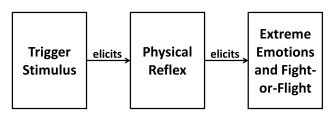
The Neural Repatterning Technique focuses on stopping or reducing the emotional response to misophonia by first eliminating or reducing the physical misophonic reflex response. The trigger stimulus causes a physical reflex in almost everyone with misophonia, and this physical reflex elicits the emotional response.

If the physical reflex is eliminated, the primary connection between the trigger and the emotional response is disrupted, as shown below.
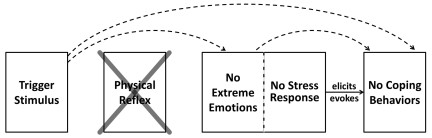
In most cases, the physical reflex is not completely eliminated with NRT. The reflex is typically greatly reduced and may fade with time or remain weak, resulting in a greatly reduced emotional response to the trigger.
Counterconditioning the Misophonia Reflex
Experiencing a trigger appears to strengthen the misophonic-conditioned reflex. The misophonic emotions and tightened muscles following a trigger seem to reinforce the reflex response.
To reduce the misophonia reflex, the trigger must be paired with a smaller-than-typical reaction. This can be accomplished by reducing misophonic emotions or creating a situation in which the reflex action (tight muscle response) is reduced or relaxed immediately after the trigger.
This effect can be achieved by pairing the trigger with positive emotions (relaxed or happy rather than upset) or through muscle relaxation, provided relaxation occurs before the trigger. If the nervous system perceives a weaker reflex response shortly after the trigger, the reflex response may gradually diminish.
This process is known as counterconditioning. However, within the short pairing window after a trigger, counterconditioning alone is often not powerful enough to overcome the misophonic emotional response. As a result, spontaneous elimination of reflexes through counterconditioning alone is uncommon, although such cases have occurred.
To address this limitation, the trigger used in NRT is intentionally reduced. By diminishing the intensity of the trigger, the physical reflex is reduced to a very small response. This process is similar to allergy desensitization treatments, where very small exposures gradually reduce reactivity. The NRT approach uses small trigger exposures to allow the nervous system to adapt and reduce its response.
Recorded triggers are typically used, although live triggers have also been effective. A rating scale from zero to five is used to assess the strength of the misophonia reflex, with five indicating a strong trigger and zero indicating no reaction. The target response level during treatment is typically around one, allowing the person to remain positive, calm, and relaxed.
The trigger is paired with a positive stimulus such as calming music, uplifting music, positive imagery, pleasant conversation, massage, or meaningful personal imagery. The positive stimulus should produce a calm or positive emotional state that can be paired with the reduced trigger stimulus. The Trigger Tamer app is used to automate the process.
How to Make the NRT Trigger Tamer Work for You
The Neural Repatterning Technique does not cure misophonia, but it can significantly reduce the misophonic reflex response. The goal is to reduce the reflex response to a level similar to an eye blink — small, brief, and non-distressing. For the technique to be effective, the response must include a physical reflex (not only an emotional reaction), and the reflex must resolve quickly.
Focus on the Physical Reflex
NRT is designed to reduce the physical misophonic reflex that precedes the emotional response. The technique is most effective when the reflex involves a skeletal muscle (e.g., jaw clench, shoulder jerk, hand clench), as these muscles can be intentionally relaxed with practice.
Reflexes that are internal and linger (e.g., stomach constriction, intestinal responses, sexual arousal) are less responsive to this method because they cannot be quickly relaxed or stopped.
Use Appropriate Trigger Intensity
Triggers should be presented at a very low intensity — strong enough to produce a small physical reflex (approximately “1” on a 0–5 scale), but not strong enough to cause distress.
As the reflex response decreases, the volume or duration of the trigger may be gradually increased to maintain a mild physical response.
Observed practice ranges include:
-
Trigger spacing: approximately 15 seconds to 2 minutes
-
Meaningful change sometimes observed after 100–300 exposures
-
In some cases, benefit may be limited even after extensive repetition
Practice Consistently
Consistent practice supports learning and reflex reduction.
Typical practice guidelines:
-
30 minutes per day
-
4–6 days per week
-
Sessions should remain calm and positive
Positive or calming stimuli (e.g., preferred music, pleasant imagery) should be paired with the low-intensity trigger.
Progression to Real-World Triggers
Once reflex responses are reduced for multiple recorded examples of a trigger (typically 2–4), practice may gradually transition to real-world situations. Reflex responses may still occur initially but are often significantly reduced.
Confirm That Learning Is Occurring
Indicators of progress may include:
-
A need to increase trigger intensity to maintain a mild reflex
-
Reduced reflex strength in daily life
If repeated sessions do not require any increase in trigger intensity, the treatment setup may require adjustment.
When NRT May Not Be Effective
NRT may be less effective when:
-
Triggers cannot be elicited using recordings
-
The reflex response lingers and does not resolve quickly
-
A calm or positive state cannot be achieved during sessions
-
The response is emotional without a physical reflex
Trigger Specificity Matters
NRT works best with triggers associated with a specific person or object. It is generally not effective for broad, generalized triggers (e.g., “anyone sniffling anywhere”). Conditioned reflexes are often context-dependent, and training effects may not fully generalize across environments.
Case Examples
Martha’s Story
Martha was a professional in her mid-forties with a lifelong history of misophonia ranging from mild to extremely debilitating. Efforts to reduce her symptoms included extensive work on autonomic reactivity, including breathwork and relaxation techniques, and the use of noise-reduction headsets and musician earplugs. She reduced her misophonia to the point that she rarely experienced extreme misophonic emotions, but she was still occasionally agitated by one trigger. After listening to a recording of the trigger in preparation for NRT, she reported that she became aware of the muscles behind her ear contracting when she heard the sound. She then eliminated the reflex using NRT for the trigger stimulus. With the reflex gone, the real-life trigger stimulus no longer elicited negative emotions.
Virginia’s Story
This case involves eliminating a trigger related to a family member singing around the house.
“I think probably it was about three weeks into it, I started realizing that this is really working. I have to say that I did not think anything would work. I think a lot of people feel that way who have this. And, of course, when I was young, I felt that I was the only person in the world who had ever experienced this. But after about three weeks, I started seeing the improvement. It was gradual, but it was definite. I could tell that the trigger was going away, and it was getting lighter. And then when I started experiencing the trigger in real life and realized I wasn’t having those emotions or that anger. It was like a miracle.”
The Neural Repatterning Technique is not an unpleasant treatment, but a positive experience. Virginia describes NRT treatment sessions using the Trigger Tamer app:
“I’m almost 75 years old. For all of these years, I have just tried to avoid these sounds. After I got through the apprehension of the whole thing, I began to look forward to this treatment, and hearing those sounds was amazing to me. It was life-changing.”
Other Observations
The first documented application of this approach by Dozier involved a 15-year-old boy who was triggered by family members eating, particularly his mother chewing crunchy foods. Treatment was initially conducted using live triggers paired with music. His responses diminished, though visual triggers related to jaw movement persisted. Additional sessions focusing on visual triggers led to further improvement. While misophonia was not completely eliminated, reactions were reduced to a manageable, non-upsetting level.
After assisting one of the first individuals to purchase the Trigger Tamer app, Dozier received the following message.
“I have some excellent news. I’ve been doing my work with the app every day for about 10 days, for at least an hour each session. If I’m feeling good, I can do three hours or so while I’m at work. I was gradually increasing volume, frequency and length of the trigger sound (sniffling). Today I had a conversation with my roommate, and partway through, I realized he was sniffling and I was having no physical reflex. I then began focusing on the sound as if part of me knew something was supposed to happen but I had no negative feelings each time I heard the sound.
“I have been working on crunching, and I have definitely noticed a sensitivity decrease. I even have noticed an anxiety decrease when I know I might hear the trigger. I’ve realized I still really dislike the sound, but I can handle it much better. Just the decrease in anxiety has been great.”
Additional cases included children, college students, and adults who experienced meaningful reductions in misophonic reflex responses using NRT in combination with muscle relaxation and positive pairing techniques. In some cases, reflex responses to treated triggers were eliminated, while generalized or context-dependent triggers were more resistant to change.
Case 1: 48-Year-Old Woman
Dozier's best-documented case, involving a 48-year-old woman, is described in the journal article, “Counterconditioning Treatment for Misophonia."
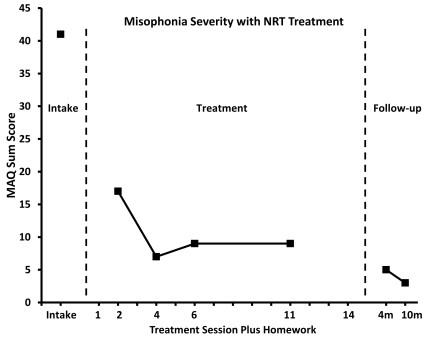
She was triggered by her husband’s eating sounds and hand movements and underwent NRT via Skype sessions. Each trigger—bread, sorbet, beard scratching, and hand-to-face gestures—was addressed with two live sessions plus four weekly homework sessions. Sound triggers responded quickly, while her visual trigger took nine weeks to reduce.
By the end of treatment, her reflex responses were minimal. She could notice triggers, look away if needed, and continue her day without emotional upheaval.
The graph below shows her Misophonia Assessment Questionnaire sum score (maximum 63) over time. She began at 41, dropped to 17 after initial treatments, reached 9 after additional sessions, and maintained only 3 at ten-month follow-up, reflecting a dramatic and sustained improvement.
Case 2: College Student
A college student home for the summer had strong triggers with her mother. She practiced muscle relaxation for a week before starting NRT, which targeted her hand-clench reflex. In a Google Play App review, she wrote:
“My life is changed forever. I finally have control over my own suffering. Finding this app has been a complete miracle. Misophonia was ruining my life to the point where I couldn’t stay in classes or couldn’t concentrate because of the noises, and decided to go to Tom Dozier for help. After just two treatment sessions using the app, I could stand being around my mother while we ate (chewing and spoons on porcelain were some of my biggest triggers). Treatment for me worked very fast and I am excited to continue to eliminate other triggers. While I cannot completely eliminate reactions in real life, I barely react to the trigger. At least not with the rage I used to.”
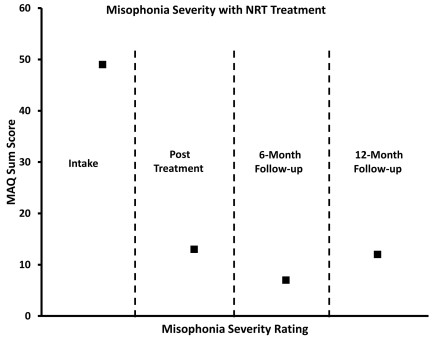
After returning to school, she successfully applied the techniques in real-life situations. Six-month follow-up showed continued reduction in overall severity and individual trigger responses. At twelve months, slight increases in general misophonia were likely due to anxiety, but her responses to treated triggers remained fully eliminated.
The Trigger Tamer Apps (iPhone & Android)
The Misophonia Institute offers two Trigger Tamer apps to support the Neural Repatterning Technique (NRT).
Misophonia Trigger Tamer (Blue Brain Icon)
The blue-brain app is the Misophonia Trigger Tamer, designed specifically for sound-based triggers. It provides precise control over audio triggers and includes a built-in recorder and sound editor, making it easy to create and manage your trigger exposures. The positive stimulus playlist supports audio recordings only.
Visual Trigger Tamer (Green Head Icon)
The green-head app is the Visual Trigger Tamer, which uses video recordings that combine visual and audio triggers. This app is ideal if audio recordings alone do not reliably trigger your responses. It allows more flexible positive stimulus playlists, including audio recordings, pictures, and videos. While it offers less control over trigger timing and options, it provides an alternative method for exposure. For recording and editing triggers, external programs are required.
Apps Allow for Flexibility and Control
-
Users can choose when and where to do NRT sessions
-
Sessions can be done at home, during a walk, or while relaxing
-
The app puts the user in control of pace and intensity
-
Progress can be adjusted based on daily readiness and emotional state
Why the Apps Matters
Manually delivering hundreds of carefully timed, very low-level triggers is impractical in real life. The Trigger Tamer apps remove that friction so users can focus on what matters most: staying relaxed, positive, and consistent with practice.
How NRT Fits With Other Treatments
NRT complements, but does not replace, other misophonia management and treatment approaches, including:
-
Sound management strategies
-
Audiologist-provided sound generators
-
Cognitive Behavioral Therapy (CBT) and Dialectical Behavior Therapy (DBT)
CBT and DBT may support emotional coping, while NRT targets the physical reflex that contributes to the misophonic response.