

2025 Misophonia Treatment Research Underway
Study at a Glance

Dr. Nate Mitchell
Misophonia Institute

Dr. Sam Spencer
University of North Texas

Tom Dozier
Misophonia Institute
Focus: Evaluating misophonia as an acquired reflex response and the effectiveness of reflex-based treatment
Lead Researcher: Sam Spencer, PhD
Treatment Process Co-Developers: Dr. Nate Mitchell and Tom Dozier
Research Location: University of North Texas, Denton Campus, Texas Intervention Development and Behavioral Science Lab
Funder: Misophonia Institute
The Misophonia Institute continues to raise funds to ensure that future projects can move forward without delay. The next goal is to expand the research pool to include a larger and more diverse group of participants—a critical step toward stronger, more generalizable results. This phase is expected to require $100,000. Every donation gets us one step closer to finding answers to help those with misophonia!
Click or Scan QR Code

Featured Topic
Before understanding what misophonia is, a person might feel they are overreacting-- or be judged as such. They also may feel a wide range of emotions, including guilt, for their reactions. This week's featured resources highlight this aspect of the condition.
The Misophonia Institute offers a range of resources to help families understand this condition. Start with the links below, and continue exploring the site for additional information and guidance.

Research and Treatment Since 2012
The directors of Misophonia Institute individually and collaboratively worked to understand misophonia and develop treatments from 2012 to 2015. In 2015, the Misophonia Institute was founded as a non-profit company to support research, awareness, and treatment.
Learn About Misophonia


About Us
The Misophonia Institute, founded in 2015, provides accurate information on misophonia, supports safe and effective treatments, and fosters collaboration among professionals and researchers to advance understanding and care. Incorporated as a nonprofit public benefit corporation in California in 2016, it received 501(c)(3) status that same year (EIN: 81-3985434).
A virtual organization run entirely by volunteers, the Institute focuses on three main goals:
-
Increase awareness of misophonia among individuals and clinicians
-
Facilitate collaboration and training for clinicians on misophonia treatment
-
Promote and support research to improve and develop effective treatments

Tom Dozier
President, Misophonia Institute
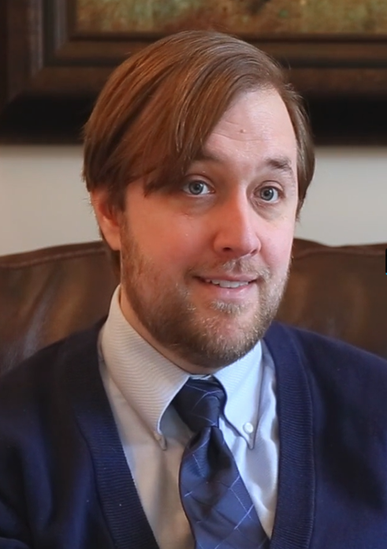
Nate Mitchell
Treasurer, Misophonia Institute

Penny Baskin
Secretary, Misophonia Institute
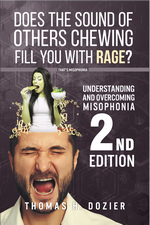
A Foundational Guide To Understanding Misophonia
Understanding and Overcoming Misophonia, 2nd edition. This extensively updated book draws on recent brain imaging research, real-life experiences, and practical management approaches to explain misophonia as a neurological condition. Tom Dozier describes how misophonia develops, why triggers cause intense distress, and how many people are able to reduce its impact over time.