

Movie theaters are often challenging for individuals with misophonia due to common trigger sounds from the snacks and beverages being consumed. However, many theaters offer assistive listening devices that can significantly reduce exposure to these sounds by delivering the movie audio directly to the listener.
At many movie theaters, patrons can request a headset intended for individuals who are hard of hearing. With the movie sound delivered directly into the ears, background noises from nearby audience members may be reduced or blocked out.
For example, at the Livermore 13 theater in Livermore, California, patrons may request wireless over-the-ear headphones at no charge. An ID is typically left at the counter while the device is in use, and theater staff activate the transmitter for the specific auditorium. The volume can be adjusted individually for comfort.
Some theaters instead provide a small hand-held receiver with a headphone jack. In these cases, individuals may bring their own headphones, including noise-canceling earbuds, and plug them directly into the receiver.
For individuals who are extremely sensitive to eating or mouth sounds, wearing earplugs underneath the theater headphones may provide additional relief. The earplugs reduce ambient noise, while the headphone volume can be increased to maintain clarity of the movie audio. Sitting near the center of the theater may also improve receiver performance.
Similar Technology in Other Venues
Assistive listening systems are not limited to movie theaters. Many churches, university classrooms, lecture halls, and performance venues also provide receivers designed to help attendees hear amplified speech more clearly.
In these settings, hand-held receivers are standard and may allow individuals to use their own headphones. When paired with noise-canceling headphones or earbuds, these systems can help listeners focus on the speaker while reducing exposure to nearby trigger sounds such as coughing, sniffing, or whispering.
In some situations, it may also be possible to introduce gentle background noise using a smartphone noise app alongside the amplified audio. This can further reduce the impact of triggering sounds without interfering with comprehension.
A Practical Technology-Based Strategy
Advances in assistive listening and personal audio technology provide useful options for managing misophonia in shared public spaces. Devices originally designed for individuals who are hard of hearing can often be repurposed to reduce exposure to triggers and improve comfort in environments where sound control is otherwise difficult.
Availability and equipment vary by location, so it is recommended to ask venue staff about assistive listening options upon arrival.

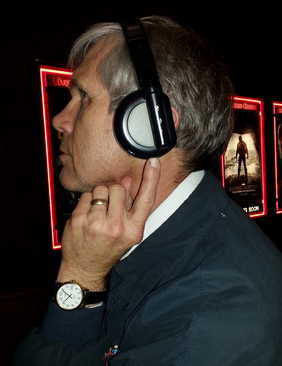
Tom Dozier, founder of the Misophonia Institute, wears a theater-provided assistive listening device and demonstrates how to adjust the volume control. This device provides an option for someone with misophonia to reduce common triggers at the local movie theater.