

Progressive Muscle Relaxation (PMR) is among the most effective treatment strategies for misophonia when the initial physical misophonic reflex involves a skeletal muscle, such as clenching a fist, tightening the jaw, or jerking the shoulders. PMR reduces the intensity of the misophonic response by training the body to relax muscles on demand, interrupting the conditioned reflex that drives misophonia.
PMR is not a concept to be understood; it is a skill developed through practice. When practiced consistently, PMR can reduce anger responses, improve overall well-being, and, in some cases, reduce or eliminate misophonic triggers over time.
Explore Sections
- Who Benefits from Progressive Muscle Relaxation (PMR)
- Progressive Muscle Relaxation (PMR) Further Defined
- Why Progressive Muscle Relaxation (PMR) Helps With Misophonia
- Progressive Muscle Relaxation Vs. Applied Relaxation
- How Progressive Muscle Relaxation (PMR) Is Practiced
- Video Introduction to Progressive Muscle Relaxation (PMR)
- Guided Audio Resources for Progressive Muscle Relaxation (PMR)
- Applied Relaxation and Repatterning the Misophonic Reflex
- Evidence and Case Examples
- Expectations and Practice Commitment
Who Benefits from Progressive Muscle Relaxation (PMR)
PMR is recommended for individuals whose initial physical misophonic reflex is a skeletal muscle contraction.
Common examples include:
- Clenching the hands or fists
- Tightening the jaw
- Pulling the shoulders upward
- Jerking or tensing a limb
If the initial physical reflex is internal (for example, stomach constriction or internal chest sensations), those muscles cannot be willfully relaxed. In such cases, PMR is unlikely to directly reduce the reflex, and alternative treatment approaches may be more appropriate.
Progressive Muscle Relaxation (PMR) Further Defined
Progressive Muscle Relaxation was developed in the early 1920s by physician Edmund Jacobson as a treatment for stress and anxiety. The technique involves deliberately tightening and then relaxing specific muscle groups to induce deep physical relaxation.
When the body enters a state of deep relaxation, several physiological changes occur:
- Decreased heart rate
- Slower respiration
- Reduced blood pressure
- Decreased skeletal muscle tension
- Lower metabolic rate and oxygen consumption
- Reduced analytical thinking
This physiological state is incompatible with panic, anger, or high emotional arousal.
PMR is one method of achieving deep relaxation, but its role in misophonia extends beyond general stress reduction.
Why Progressive Muscle Relaxation (PMR) Helps With Misophonia
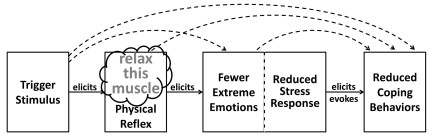
PMR benefits misophonia in two distinct but related ways.
Reducing the Emotional Response After a Trigger (Applied Relaxation)
Anger has a strong physiological component, particularly muscle tension. During a misophonia trigger, the body often responds with rapid muscle tightening. If muscles are relaxed immediately after a trigger, the brain receives conflicting signals: relaxed muscles paired with anger are incongruent. This inconsistency reduces the intensity of the anger response.
Relaxing muscles immediately after a trigger is referred to as Applied Relaxation.
Reducing the Physical Reflex Before and During a Trigger
PMR also enables muscle relaxation before a trigger occurs. If the initial misophonic reflex involves a muscle contraction, relaxing that muscle in advance can reduce the severity of the reflex when the trigger is heard.
During the first one to two seconds after a trigger, the brain evaluates the physical state of the muscle. If the muscle is more relaxed than usual, the reflex response may be slightly weaker. Repeated exposure under these conditions can lead to a gradual weakening of the reflex, a process known as lizard-brain repatterning.
Progressive Muscle Relaxation Vs. Applied Relaxation
Although closely related, these are distinct skills.
Progressive Muscle Relaxation (PMR)
- A daily practice used to build the skill of muscle relaxation
- Involves systematically tightening and relaxing muscle groups
- Develops the neural connections needed to relax muscles on command
Applied Relaxation
- The use of the relaxation skill in real-world situations
- Relaxing muscles immediately after a trigger
- Relaxing muscles before and during anticipated triggers
PMR builds the skill. Applied Relaxation applies the skill.
Because relaxing muscles without first tightening them is difficult, daily PMR practice is necessary to develop sufficient control for Applied Relaxation.
PMR functions as a form of muscle relaxation practice in which repeated training builds the ability to relax muscles on command.
How Progressive Muscle Relaxation (PMR) Is Practiced
PMR is learned through guided practice. Most individuals require at least 14 daily sessions to begin developing the skill, with continued improvement through ongoing practice.
General practice guidelines:
- Practice once or twice daily during the learning phase
- Morning and evening sessions accelerate skill development
- Select a quiet location with minimal distractions
- Allow 20–30 minutes initially
- With proficiency, sessions may be completed in approximately 10 minutes
- Wear loose clothing and adopt a comfortable position (bed, recliner, sofa, or floor)
A typical PMR session includes:
- Several slow, deep breaths at the start
- Tensing a muscle group firmly (without straining) for 7–10 seconds
- Directing attention to the sensation of tension
- Abruptly relaxing the muscle
- Observing the contrast between tension and relaxation for 15–20 seconds
- Repeating the process for each muscle group
The goal is to adopt a passive, observational attitude toward muscle sensations rather than focusing on effort or analysis.
Video Introduction to Progressive Muscle Relaxation (PMR)
Progressive Muscle Relaxation (PMR) is a practical skill that helps calm the body’s physical reflex to misophonia triggers and can be learned through guided practice.
The video (10:38) below explains. Click here for an edited transcript instead:
- The foundations of Progressive Muscle Relaxation
- Why PMR is effective for misophonia
- How muscle relaxation affects the physical reflex
- What to expect during the learning process
In the next video (3:28), a participant discusses her experience with PMR.
Guided Audio Resources for Progressive Muscle Relaxation (PMR)
Guided audio recordings are the most effective way to learn PMR. Practice PMR twice/day using the beginner audio file at least 2-4 times before moving on to the intermediate one. Once mastered, use an advanced version and practice daily as if it were assigned homework. Timing-only audios are particularly useful for individuals who are triggered by spoken instructions.
Guided Audios for Progressive Muscle Relaxation
| Beginner | Intermediate | Expert | Timing-Only |
|---|---|---|---|
| Most thorough guided audio: PMR by Dartmouth College (24:53) |
PMR by Arizona State University (15:26) |
Expert Version, by Tom Dozier (12:38) Short Expert Version, by Tom Dozier (9:46) |
Timing only: 3 chimes for breathing, high-pitch to tighten, chime to relax. 30s start breathing, 10s tighten, 20s relax (10:35) Timing only: 3 chimes for breathing, high-pitch to tighten, chime to relax. 30s start breathing, 7s tighten, 15s relax (8:11) |
Applied Relaxation and Repatterning the Misophonic Reflex
Misophonia triggers often occur in clusters, such as eating sounds combined with typing or breathing. As a result, Applied Relaxation is often practiced continuously in real-world situations.
The most important muscle to relax is the muscle involved in the initial physical misophonic reflex. Relaxing other muscles may be helpful, but repatterning occurs when the reflex muscle is relaxed before or during the trigger.
During the critical training window immediately following a trigger, the brain detects a more relaxed muscle state. Over repeated exposures, the reflex response may weaken and, in some cases, extinguish.
Related links:
- Neural Repatterning Technique (NRT) (webpage)
- Trigger Tamer app (webpage)
- Neural Repatterning Technique and the Trigger Tamer (video)
Evidence and Case Examples
After years of relaxing after being triggered to control his anger, one individual discovered he could relax before triggers. As a member of a patient panel at a Misophonia Association convention, he reported that he had virtually eliminated his misophonia by relaxing his muscles during trigger situations. This example shows Applied Relaxation at its best.
In the journal article “Treating the Initial Physical Reflex of Misophonia with the Neural Repatterning Technique: A Counterconditioning Procedure,” Misophonia Institute founder Tom Dozier describes how a woman started with PMR and then practiced relaxing to very small triggers during Neural Repatterning Technique (NRT) treatments using the Trigger Tamer app. After eliminating two triggers with the NRT treatment, she relaxed her muscles in real-life situations and continued to reduce her misophonic triggers.
These cases illustrate how PMR and Applied Relaxation can work together over time to reduce or overcome misophonia.
Expectations and Practice Commitment
PMR is an effective treatment when practiced consistently.
Key expectations:
- Daily practice for at least 14 days is required to begin developing the skill
- Continued practice over weeks or months improves effectiveness
- Progress is typically gradual
- PMR also improves general well-being, which can further reduce misophonia severity
The effectiveness of PMR becomes apparent through consistent practice.